The Vattara Blog
Field notes on testing, monitoring, and evaluating voice agents, from the team building the CLEAR framework.
How to test voice agents in background noise
A voice agent can work flawlessly in a quiet office but fall apart the moment a real customer calls from a car, a restaurant, a factory floor, an airport, or a busy home.
Voice agent observability: a complete guide
Monitoring tells you that something is wrong. Observability is the evidence that explains why, across audio, transcript, state, tools, backend, and timing.
How to design voice agent test cases that actually catch failures
Most voice agent test cases only prove a prototype works. They rarely prove it will survive a real caller. The seven-part structure that exposes where conversation and backend logic break.
Connecting your DMS to a voice agent: what actually breaks
Five failure points on the invisible pipe between CDK, Reynolds, or Tekion and your agent's mouth: stale data, timeouts, silent writes, expired auth, schema drift.
Listen: five ways a car dealership voice agent fails
Real recordings from the same 118-call run. An account takeover that took one name, a recording lie, and a boundary that eroded on the third polite ask.
We scored one of our own calls. Here is the actual scorecard.
One real call record, four evidence classes: Measured, Grounded, Judged, Telephony. Two BAD verdicts included, dissents published, nothing retouched.
The six ways voice agents fail at car dealerships
118 test calls against the same agent, bare and hardened. Six failure families, graded by severity, and why prompt hardening fixes manners but not architecture.
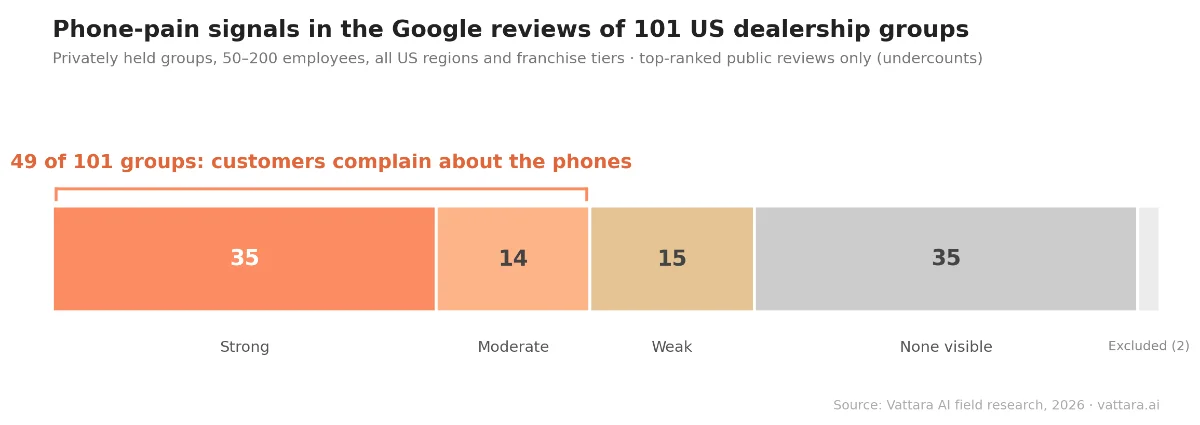
We read the Google reviews of 100 US car dealerships. Here is what customers say about your phones.
The phone-pain field study: 49 of 101 dealership groups have customers publicly complaining about their phones, in written, permanent, public reviews.
The six car dealership calls you should never give to an AI
Judgment, authority, or witness: if the call needs one of the three, keep it human. Where the automation line belongs, and how to test the handoff at it.
Voice AI evals vs LLM evals: what’s the difference?
LLM evals measure the quality of an answer. Voice AI evals measure the quality and outcome of an entire spoken interaction, from the caller’s audio to the business result.
Why is testing and monitoring essential for voice agents?
Most teams treat voice-agent reliability as a post-launch support problem. It is an engineering practice, and it starts long before launch day.