We recently researched 101 mid-sized US dealership groups. Not their websites. Not their ad spend. Their Google reviews, specifically the ones that mention the phone.
We were not looking for complaints about cars. We were looking for complaints about calls. Missed calls. Unreturned calls. Voicemail boxes that never get checked.
Here is the headline number:
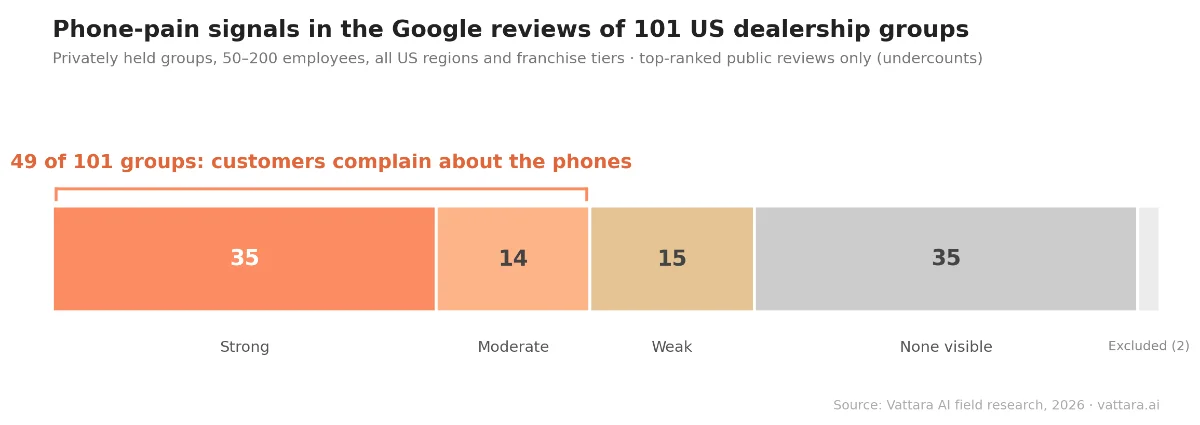
In 49 of the 101 dealership groups, customers complained about the phone experience in publicly visible reviews. In 35 of those, the complaints were strong and repeated. And because we only sampled the most prominent reviews per store, these numbers are a floor, not a ceiling. The real rate is higher.
Your customers are not just frustrated with your phones. They are leaving written, public, permanent evidence of it, attached to your name, where every future customer reads it before they ever dial.
Who we looked at
The sample was built to look like the middle of the US retail auto market, not its extremes.
- 101 dealership groups, all privately held, roughly 50 to 200 employees each. No mega-consolidators, no single-point used lots.
- Coast to coast. The sample spans New England and the Northeast, the Midwest and the Plains, the South, Texas, the Mountain West, and the West Coast including Southern California and Nevada.
- Every franchise tier. Domestic volume stores (Ford, Chevrolet, CDJR, Buick GMC), import volume stores (Toyota, Honda, Hyundai, Mitsubishi), and luxury franchises (Porsche, Audi, Land Rover, Mercedes-Benz).
- Most groups operate multiple rooftops with dedicated service departments and BDC or reception staff, meaning the phone is a managed function, not an afterthought.
The point of the mix: phone pain is not a small-store problem or a budget-brand problem. The patterns below showed up at a five-store luxury group in the Northeast and at a domestic volume store on the Plains, in nearly identical words.
What we did
Short version, because methodology matters:
- We pulled recent public Google reviews for all 101 groups, across their sales, service, and BDC touchpoints.
- We flagged every review that described a phone or communication failure: unanswered lines, full voicemail boxes, promised callbacks that never came, hold and transfer loops.
- We classified each group as strong (repeated, explicit phone complaints), moderate (clear but isolated), weak (implied), or none visible.
The result:
| Signal | Groups | Share |
|---|---|---|
| Strong phone-pain complaints | 35 | 35% |
| Moderate | 14 | 14% |
| Weak / implied | 15 | 15% |
| None visible in sampled reviews | 35 | 35% |
| Unmatched / excluded | 2 | 2% |
One honest caveat. "None visible" does not mean "no problem." It means the top-ranked reviews we sampled did not surface one. Most unhappy callers never write a review. They just call the dealer down the road.
The five patterns
The complaints were not random. They clustered into five patterns, and the same five showed up in every region and every brand tier.
(We are paraphrasing rather than quoting reviews verbatim. Every pattern below appeared word-for-word recognizably across multiple stores. Naming or quoting individual dealerships is not the point of this report.)
1. The ring-out
The line rings. Nobody answers. The voicemail is full. The customer hangs up.
Reviewers described this in almost mechanical language: call the service line, listen to it ring, hit a voicemail box that cannot accept new messages, give up. At more than one group, reviewers said the store never answers, as a standing fact about the business rather than a bad day.
This was the single most common pattern. It is also the most expensive one, because the customer who gets a ring-out does not try again tomorrow. They call your competitor in the next 10 minutes.
2. The callback that never comes
The call gets answered. Someone promises to call back with a quote, a status, an appointment. Nobody does.
This pattern is worse than the ring-out in a specific way: the customer did their part. They reached a human, stated their need, and got a commitment. The broken promise converts a service complaint into a trust complaint. Trust complaints are the ones that end relationships, not transactions.
3. The hold-and-transfer maze
Answered, then bounced. Sales to service. Service to parts. Parts back to a voicemail.
At one import store, a reviewer described spending most of an afternoon across calls and holds just to get a status on a vehicle already in the shop, and in the same breath disputed a four-figure repair recommendation they said they never authorized. Notice the sequence: the communication failure came first, the money dispute second. When customers cannot reach you, every charge becomes suspicious.
4. The after-hours black hole
Service departments keep service-department hours. Customers do not. Reviewers repeatedly described calling in the evening or on the weekend into pure dead air, with no path to even leave a usable message.
Every one of those calls had intent behind it. A repair order. A test drive. A recall question. The intent does not wait for Monday morning.
5. "We're short-staffed"
The most revealing pattern was dealerships explaining themselves inside their own review replies. More than one store's team openly cited staffing shortages when apologizing for missed calls and slow responses.
We believe them, and we sympathize. BDC and service-advisor turnover is a real, structural problem. But from the customer's side of the glass, "we're short-staffed" and "we don't care" produce the identical experience: a phone that does not get answered.
What a missed service call costs you
We are not going to hand you industry-average numbers here, because averages hide more than they reveal and you should not trust a vendor blog's math anyway. You already have better numbers than any report: your own.
Do this instead. Three inputs, one multiplication:
- Inbound service calls per day. Your phone system or BDC report has this. If you genuinely do not know it, that is finding number one.
- Share that go unanswered or unreturned. Same report. Count abandoned calls and voicemails older than one business day.
- Your average customer-pay repair order. Your DMS has this to the dollar.
Multiply: (daily missed calls) x (the fraction you believe were ready to book, be conservative) x (your average CP RO) x 25 working days. That monthly figure is what pattern 1 alone costs one rooftop. It does not include the sales calls, the parts calls, or the review that gets written afterward.
For most groups we looked at, even brutally conservative assumptions on lines 1 and 2 produce a number that would get any other department a management meeting.
Why we are telling you this
Vattara is not a voice agent company. We do not sell you an AI to answer these calls. We test and monitor the ones you deploy.
We ran this research because dealership groups are adopting AI phone agents fast, and the pitch they hear is always the same: never miss a call again. The pitch is not wrong. A well-built voice agent genuinely erases patterns 1 and 4, and most of 3.
But here is what nobody tells you: a badly built voice agent recreates pattern 2 at scale. An AI that answers instantly, sounds confident, promises a callback, and then drops the ticket has not fixed your phone problem. It has automated it. We have watched this happen in our own test lab: a synthetic caller who said "I want a person, now" was given a callback promise instead. It was the third callback promise that character had received. The reviews written about you next year will not say "nobody answered." They will say the robot lied to me, and those reviews will be worse.
The phone was already your most reviewed, least measured department. Adding AI to it raises the stakes in both directions.
Three things to do this week
No product required for any of these.
- Call your own store. Twice. Once during lunch, once at 6:45 pm. Ask for a service appointment on a vehicle you do not own. Time everything. Most GMs have never done this.
- Read your last 25 Google reviews and count phone mentions. If two or more mention calls, callbacks, or voicemail, you are in the 49%, and your customers already told you where the leak is.
- If you already run a voice agent, ask your vendor one question: "Show me the last 10 calls where the agent failed, and what each one cost." If they cannot, you are not monitoring your phone. You are hoping.
Vattara tests and monitors AI voice agents for automotive retail. We run dealership-specific scenarios, from angry warranty callers to two-party consent states, against your agent before your customers do.