Vapi Voice Agent Testing Checklist: Before You Go Live
Use this Vapi voice agent testing checklist to validate conversations, accuracy, latency, tool calls, interruptions, security, and production readiness.
Vimal KumarHead of Marketing, Vattara · October 26, 2026 · 4 min read
Ten sections, 64 checks. One failed identity check can block a launch that passed everything else.
What Should You Test Before Deploying a Vapi Voice Agent?
Before deploying a Vapi voice agent, test whether it can understand callers, complete intended tasks, execute tools correctly, handle interruptions, recover from errors, and deliver acceptable response times.
A successful demonstration call does not guarantee production readiness. Real customers may provide incomplete information, change their requests, speak with unfamiliar accents, interrupt responses, or encounter backend failures.
Use this checklist to evaluate your Vapi assistant systematically.
0 checks
1Basic Agent Configuration0 / 6
2Conversation Accuracy and Understanding0 / 7
3Speech Recognition and Audio Quality0 / 6
4Interruptions and Turn-Taking0 / 6
5Tool Calls and API Integrations0 / 7
6Task Completion and Business Outcomes0 / 6
7Latency and Performance0 / 6
8Security, Privacy, and Compliance0 / 6
9Automated Evaluation and Regression Testing0 / 7
10Production Readiness and Observability0 / 7
How to Use This Vapi Testing Checklist
Begin with manual test calls in the Vapi dashboard to validate the basic conversation flow. Use Vapi Evals for decision-level checks and Simulations for complete conversational journeys.
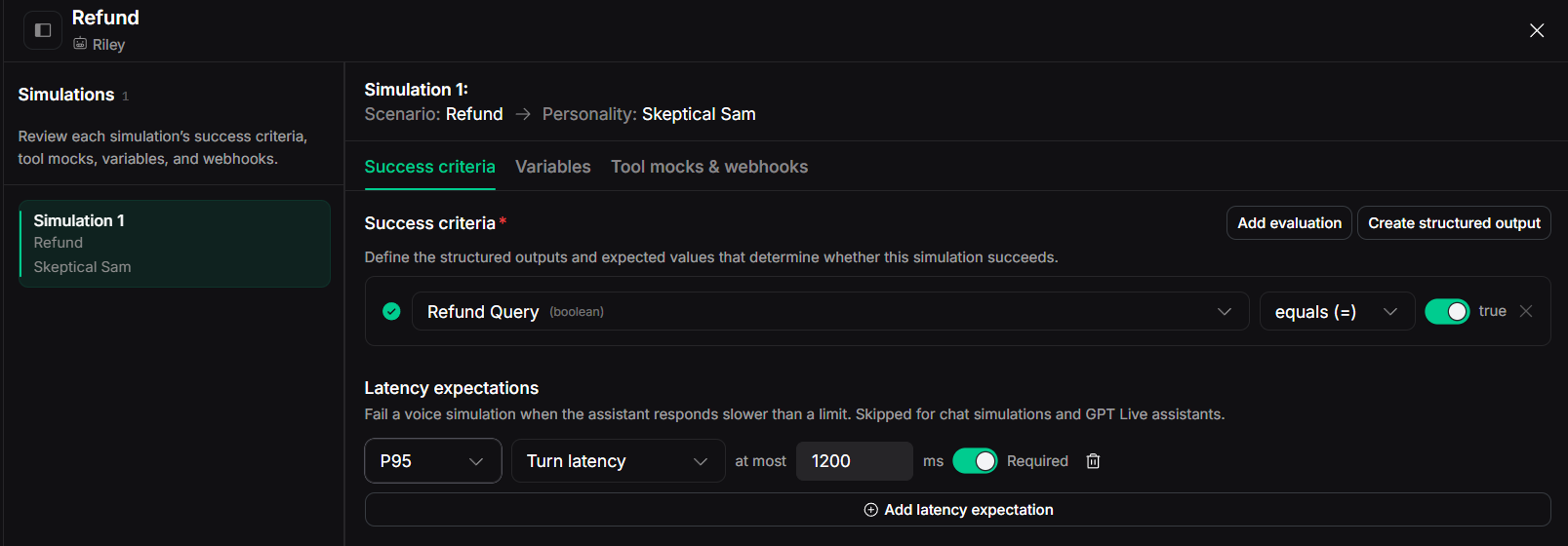
Success criteria on a Vapi simulation: an expected structured-output value, plus a P95 turn-latency limit.
Next, test realistic audio conditions, integrations, interruptions, and failure recovery. Record results against defined acceptance criteria rather than marking a test as passed simply because the agent produced a response.
For production deployments, repeat important tests after every meaningful change to prompts, models, speech providers, tools, or business workflows.
When Is a Vapi Voice Agent Ready for Production?
A Vapi voice agent is ready for production when critical customer journeys pass required tests, security and authorization checks pass, integrations behave reliably, and measured performance meets the application's acceptance criteria.
No universal passing percentage guarantees reliability. A failed identity verification test may block deployment even when nearly every other test passes.
Vapi provides native capabilities for assistant evaluations, simulations, and call investigation. Teams requiring broader quality assurance can complement those capabilities with dedicated voice AI testing and observability workflows.
Vattara AI helps teams evaluate, test, and observe voice AI systems across development and production.
Your calls, our evidence
Building voice agents with Vapi?
Explore Vattara AI to build a more systematic approach to voice agent quality, regression testing, and ongoing performance evaluation.
Vapi is a trademark of its respective owner. Vattara AI is not affiliated with or endorsed by Vapi. Product capabilities described here reflect Vapi’s public documentation at the time of writing; verify features for your plan and deployment.
ChecklistVapi testingVoice AI testing
Vimal Kumar
Head of Marketing, Vattara
Building the neutral certifier for voice AI agents. We test live voice agents over real telephony and return a defensible report card.