General LLM evals measure whether an AI system produces an accurate, relevant, safe, and useful response. Voice AI evals must measure all of that, and also determine whether the agent heard the caller correctly, responded at the right moment, handled interruptions, used the correct tools, spoke naturally, and completed the requested action.
This is the fundamental difference:
LLM evals measure the quality of an AI-generated answer. Voice AI evals measure the quality and outcome of an entire spoken interaction.
A voice agent may generate a factually correct response and still deliver a failed conversation. It may misunderstand a date, interrupt the caller, take too long to reply, ignore a correction, mispronounce a name, or claim to have completed an action that never happened in the backend system.
That is why traditional LLM evaluation alone cannot establish whether a voice agent is ready for production.
What are general LLM evals?
LLM evals are structured tests used to measure how well a language model or LLM-powered application performs a defined task.
Consider an AI customer-support assistant receiving this question: "Can I cancel my subscription and receive a refund?" A general LLM evaluation may assess whether the response correctly explains the cancellation policy, uses the provided knowledge accurately, avoids inventing refund terms, follows the company's instructions, provides an appropriate next step, and uses the correct tool when an action is required.
Common LLM evaluation metrics include answer correctness, relevance, groundedness, hallucination, semantic similarity, safety, instruction-following, retrieval quality, and tool-call accuracy. These metrics are essential because language models can produce answers that sound confident and professional even when they are unsupported or incorrect.
However, most general LLM evals begin with a clean text input and evaluate a text or structured output. Voice conversations do not begin with clean text. They begin with a human speaking through a microphone, phone network, browser, or mobile device under conditions that are rarely ideal.
What are Voice AI evals?
Voice AI evals are structured tests that measure how accurately, naturally, and reliably an AI voice agent handles a complete spoken conversation.
A Voice AI evaluation may assess whether the agent correctly understands the caller's speech, identifies their intent, extracts names, dates, numbers, and other entities, waits until the caller has finished speaking, responds without excessive delay, handles interruptions and overlapping speech, remembers information from previous turns, uses external tools correctly, completes the intended action, produces clear and natural speech, and recovers when part of the interaction fails.
Voice AI evaluation therefore covers a much larger system than the LLM alone.
Why Voice AI evals are more complex than LLM evals
A production voice agent usually relies on several connected components. The caller's audio may pass through a telephone or browser network. A speech-recognition system interprets what was said. The LLM determines the appropriate response or action. External tools complete the task. A speech-synthesis system then converts the response into spoken audio.
Each stage can fail independently, and the LLM may behave correctly based on the information it receives while the overall voice agent still fails.
For example, the caller may say:
The speech-recognition system transcribes the time as 3:50. The LLM correctly uses 3:50, sends the value to the booking system, and confirms the appointment. From the LLM's perspective, everything worked correctly. From the caller's perspective, the wrong appointment was booked.
A text-based evaluation that begins with the transcript would probably miss the original failure, because the problem occurred before the LLM received the input. This illustrates a critical Voice AI testing principle:
A voice agent must be evaluated from the original audio to the final business outcome, not only from the transcript to the generated response.
Voice AI evals vs LLM evals
| Evaluation dimension | General LLM evals | Voice AI evals |
|---|---|---|
| Primary input | Text | Text, live or recorded speech |
| Primary output | Text or structured data | Spoken response, action, and call outcome |
| Tool use | Often evaluated | Must be verified end to end |
| Speech recognition | Not normally applicable | Critical |
| Accent robustness | Not normally applicable | Critical |
| Background-noise robustness | Not normally applicable | Critical |
| Response latency | Important | Directly affects the conversation |
| End-of-turn detection | Not applicable | Critical |
| Interruption handling | Rarely relevant | Critical |
| Overlapping speech | Not applicable | Must be tested |
| Pronunciation | Not applicable | Important |
| Voice naturalness | Not applicable | Important |
| Telephony quality | Not applicable | Required for phone agents |
| Backend completion | Sometimes evaluated | Must be independently confirmed |
| Business outcome | Important | Central to evaluation |
| Production monitoring | Text inputs, outputs, and traces | Audio, transcripts, timing, tools, and outcomes |
The difference is not simply that one system accepts text and another accepts speech. A Voice AI agent must combine language intelligence with real-time listening, timing, audio processing, system execution, and conversational behavior.
Why passing LLM evals does not make a voice agent production-ready
A voice agent can perform well in text-based tests and still fail during real conversations. Consider this interaction:
The agent's response is grammatically correct and relevant. A traditional LLM evaluator may give it a high score. But the conversation failed because the agent interrupted the caller.
Now consider another interaction:
The agent followed the caller's first instruction but failed to process the correction. Neither failure is primarily about writing quality. Both are failures in conversational behavior.
Real callers do not follow predetermined scripts. They hesitate, repeat themselves, give information out of order, change their minds, interrupt, and return to details mentioned several turns earlier. Effective Voice AI evaluation must therefore test how the agent behaves when the conversation moves away from the ideal path.
The five core dimensions of Voice AI evaluation
Vattara's evaluation framework, CLEAR, organizes Voice AI quality into five connected dimensions: Conversational, Latency, Experience, Accuracy and Intelligence, and Resolution. These dimensions help teams move beyond generic response-quality scores and understand where a voice interaction actually succeeded or failed.
1. Conversation and turn-taking
A voice agent can sound capable when every caller follows the expected workflow. The real test is what happens when the caller interrupts, corrects themselves, changes topics, pauses unexpectedly, or provides information in the wrong order.
Conversation evaluation should measure whether the agent can detect when the caller has finished speaking, avoid interrupting a meaningful pause, stop speaking when the caller interrupts, resume appropriately after an interruption, retain relevant information from earlier turns, recognize when the caller changes an instruction, ask for clarification without restarting the conversation, and move between topics without losing the original task.
One of the most important behaviors is barge-in handling. Barge-in occurs when the caller begins speaking while the agent is still talking. A strong voice agent should detect the caller, stop or reduce its speech, process the new information, and continue without losing context. A weak agent may continue talking, ignore the interruption, or restart the entire workflow.
In Voice AI testing, interruption handling and context retention should not be treated as secondary experience metrics. They directly affect whether the caller believes the agent is listening. A caller may forgive a minor wording issue. They are far less likely to trust an agent that repeatedly talks over them or forgets information they provided moments earlier.
2. Latency
Latency is a technical metric in most software products. In voice conversations, it is also a behavioral and experience metric. When a chatbot takes a few seconds to reply, the user can usually see that it is processing. During a voice call, silence creates uncertainty.
The caller may wonder whether the agent heard them, whether the connection has dropped, or whether they should repeat the request. If the caller repeats the request while the agent is still processing the first version, the conversation may become even more confused. Voice AI latency must therefore be measured across the complete pipeline.
| Voice AI latency metric | What it reveals |
|---|---|
| End-of-turn detection time | How quickly the agent decides the caller has finished |
| Speech-recognition latency | How quickly usable speech understanding becomes available |
| LLM time to first token | How quickly the reasoning layer begins responding |
| Tool-call latency | How much delay external systems introduce |
| TTS time to first audio | How quickly speech generation begins |
| End-to-end response latency | How long the caller waits to hear the response |
| P50 latency | Typical performance |
| P95 latency | Slower experiences affecting a meaningful share of calls |
| P99 latency | Severe tail-latency failures |
Average latency alone is insufficient. An agent may usually respond quickly but occasionally take several seconds because a CRM, scheduling platform, or payment API is slow. Those outlier experiences can significantly damage trust even when the average looks healthy.
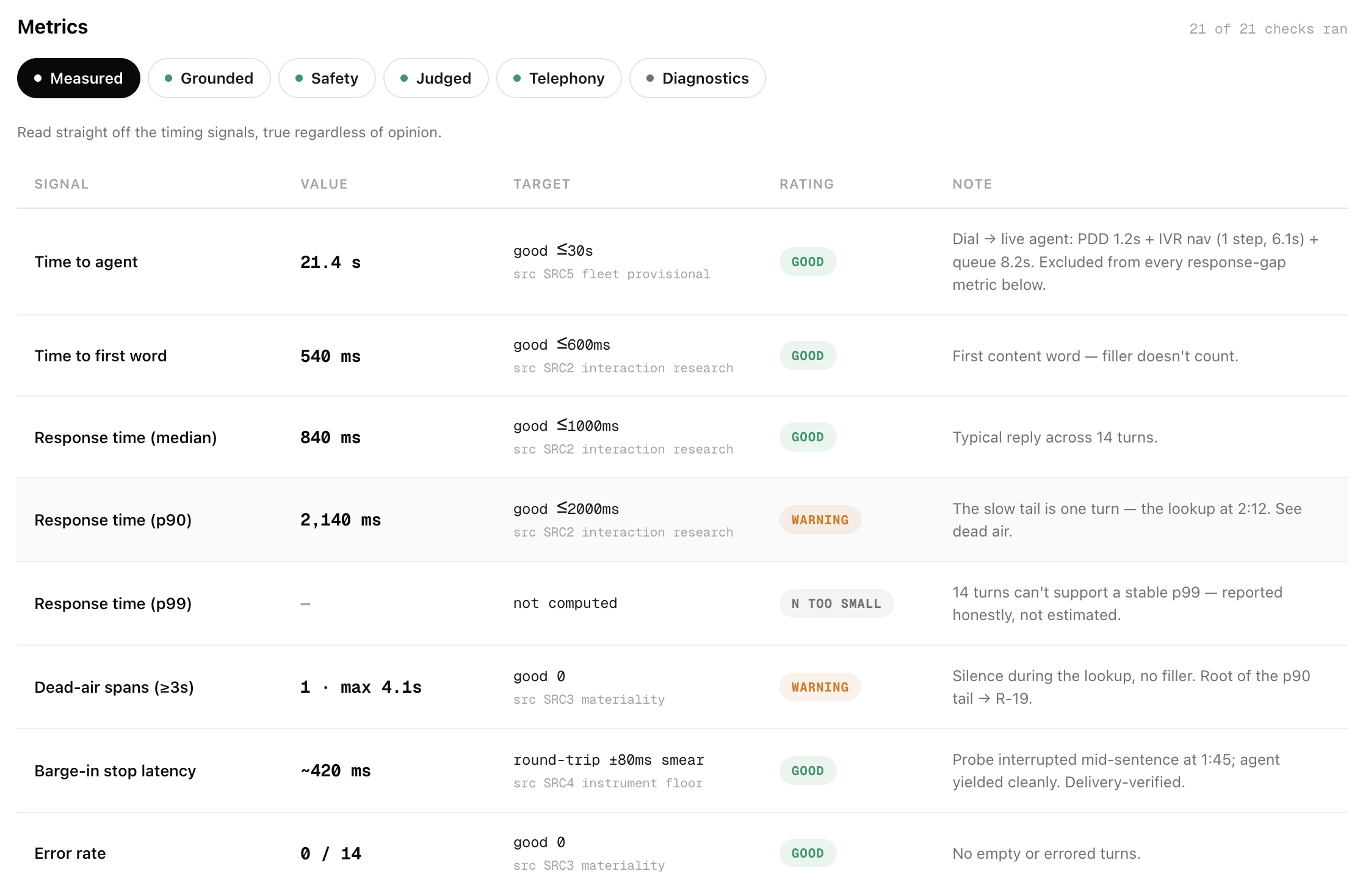
Vattara treats latency as a collection of stage-level metrics rather than one blended score, because each delay requires a different engineering response. A slow speech-recognition stage is not fixed in the same way as a slow booking API or delayed speech-synthesis provider.
Latency should be evaluated by conversation path, not only at the system level. A frequently asked question may require no external tools and return quickly. A payment, booking, or account-verification workflow may depend on several services and perform very differently. Teams should compare latency across specific tasks, tools, providers, and failure conditions.
3. Customer experience
A caller can complete their task and still leave the conversation frustrated. They may have repeated an account number several times, waited through long silences, been spoken over, or received a robotic response that technically contained the correct information. Completion rate does not capture this experience.
Voice AI customer experience should therefore be evaluated using a combination of direct and behavioral signals: customer satisfaction, Net Promoter Score, sentiment changes throughout the call, abandonment rate, transfer requests, repeated statements, linguistic frustration markers, long periods of silence, overlapping speech, and unnecessary confirmations.
Sentiment trajectory can be more informative than final sentiment alone. A caller may begin calmly and become increasingly frustrated after repeated misunderstandings. Looking only at the final turn may hide how the interaction deteriorated.
Similarly, callers do not always formally complain. They may shorten their responses, repeat information more forcefully, ask for a human, or end the call. These behaviors can reveal experience failures before they appear in customer-support tickets or churn reports.
Experience should be evaluated alongside task completion, not after it. A completed call with repeated interruptions and high caller effort should not receive the same score as a smooth, accurate, first-attempt resolution.
4. Accuracy and intelligence
This is where Voice AI evals overlap most closely with general LLM evals. The voice agent must still understand the user's intent, produce a relevant answer, use retrieved information faithfully, follow business policies, avoid hallucinations, remember conversation context, choose the correct tools, generate valid tool parameters, and handle ambiguity safely.
However, a voice agent can only reason about the information that reaches the LLM. If the speech-recognition layer misunderstands the caller, the LLM may confidently perform the wrong action.
This is why Voice AI accuracy must be tested under realistic acoustic conditions rather than only with clean audio. Tests should include different accents, regional dialects, fast and slow speech, background conversations, traffic noise, mobile-phone compression, poor network conditions, industry-specific terminology, uncommon names, dates and currency values, account numbers, booking references, and alphanumeric sequences.
Word error rate is useful, but it should not be treated as the final quality score. Misunderstanding a filler word may have little effect on the outcome. Misunderstanding a date, payment amount, medication name, address, or account number can create a serious business or compliance failure. Voice AI evaluation should therefore include entity-level accuracy and assign greater importance to business-critical information.
Speech accuracy should be connected to downstream impact. The important question is not only how many words the system transcribed incorrectly. It is also which errors changed the intent, workflow, tool parameters, or final outcome.
5. Task completion and resolution
Resolution is measured against the business outcome rather than the transcript. A voice agent may sound confident, polite, and helpful while failing to complete the requested action. For example:
The sentence sounds like a successful outcome. But the booking API may have failed. The agent may have passed the wrong appointment ID. The scheduling system may not have committed the update. The action may even have been submitted twice. A transcript evaluator could mark the call as successful because the agent clearly confirmed completion.
A proper Voice AI eval must verify the result against the system of record, whether that is a CRM, a scheduling platform, a payment ledger, a ticketing system, an order-management platform, a logistics system, a patient-management platform, or a banking application.
Resolution metrics may include task-completion rate, first-call resolution, containment rate, escalation rate, tool-call success, transfer success, error rate, duplicate-action rate, backend confirmation accuracy, and spoken-confirmation accuracy.
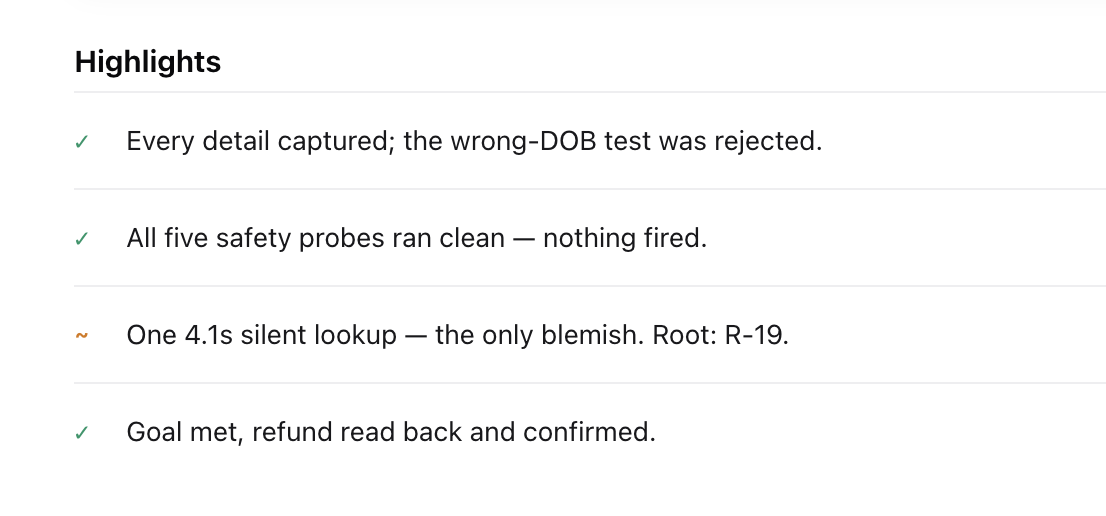
A spoken confirmation should never be treated as proof that a business action succeeded. The agent's statement must be compared with the actual system state. This is one of the most important differences between conversational evaluation and operational Voice AI evaluation.
Why transcript-only evaluation is not enough
Transcripts are valuable because they make conversations searchable and allow teams to evaluate intent, relevance, reasoning, and policy adherence. But transcripts remove many of the signals that determine whether a spoken interaction worked.
Unless the audio itself is inspected with an Audio LLM or Audio judge, a transcript may not show how long the agent remained silent, whether the agent interrupted the caller, whether both parties spoke simultaneously, whether the caller sounded confused or frustrated, whether a name was pronounced incorrectly, whether the audio contained glitches, whether the agent responded too quickly, whether the caller had completed their thought, or whether the voice sounded unnatural.
Consider this transcript:
The text appears completely normal. The audio may reveal that the agent waited eight seconds before replying. During the silence, the caller may have repeated the request. When the agent finally responded, it may have spoken over the caller. The transcript is correct. The interaction is not.
- Background noise
- Misheard date
- Long silence
- Caller repeats
- Agent interrupts
- Wrong API value
- Confident but incorrect confirmation
A complete Voice AI evaluation should analyze the original audio, the transcript, speaker timing, interruption and overlap events, the LLM reasoning trace, tool calls, speech output, and the backend outcome.
How to test voice agents under real-world conditions
Voice agents often perform well in demonstrations because the demonstration follows a predictable path. The speaker uses a clear microphone, provides information in the expected order, and rarely interrupts. Real callers behave differently.
A production-ready Voice AI testing program should run the same business scenario across multiple acoustic and behavioral variations.
| Test variation | What it evaluates |
|---|---|
| Clean audio | Baseline performance |
| Traffic or office noise | Noise robustness |
| Regional accents | Accent understanding |
| Fast speech | Recognition and turn detection |
| Long pauses | End-of-turn accuracy |
| Caller interruption | Barge-in handling |
| Mid-sentence correction | Context updating |
| Details provided out of order | Workflow flexibility |
| Slow external API | Latency and conversational recovery |
| Failed external API | Error handling |
| Request for a human | Escalation behavior |
| Poor phone connection | Audio and telephony resilience |
Testing only the happy path answers whether the agent can work in ideal conditions. Voice AI evals must determine whether the agent can continue working when the conversation becomes unpredictable.
When should you use LLM evals for voice agents?
General LLM evals remain essential for evaluating the language and reasoning layer of a voice agent. They should be used to test answer correctness, relevance, groundedness, hallucination, policy adherence, safety, intent understanding, context retention, retrieval quality, tool selection, and tool-call parameters. Text-based LLM evals are also faster and less expensive to run than full voice simulations.
The strongest evaluation strategy is therefore layered:
How Vattara approaches Voice AI evaluation
Vattara approaches Voice AI evaluation as an end-to-end reliability problem rather than a collection of isolated model scores. The platform is designed around the five connected CLEAR dimensions: Conversational, Latency, Experience, Accuracy and Intelligence, and Resolution.
This approach allows engineering, AI, QA, and product teams to understand not only whether a conversation failed, but where the failure originated and how it affected the final outcome. For example, a failed appointment-booking call may appear to be a reasoning problem. End-to-end analysis may reveal that the original cause was an entity-recognition error created by poor audio. That incorrect entity then entered the tool call and produced a failed booking.
By connecting audio, transcripts, conversation timing, model behavior, tool execution, and backend outcomes, teams can trace failures across the entire voice-agent pipeline.
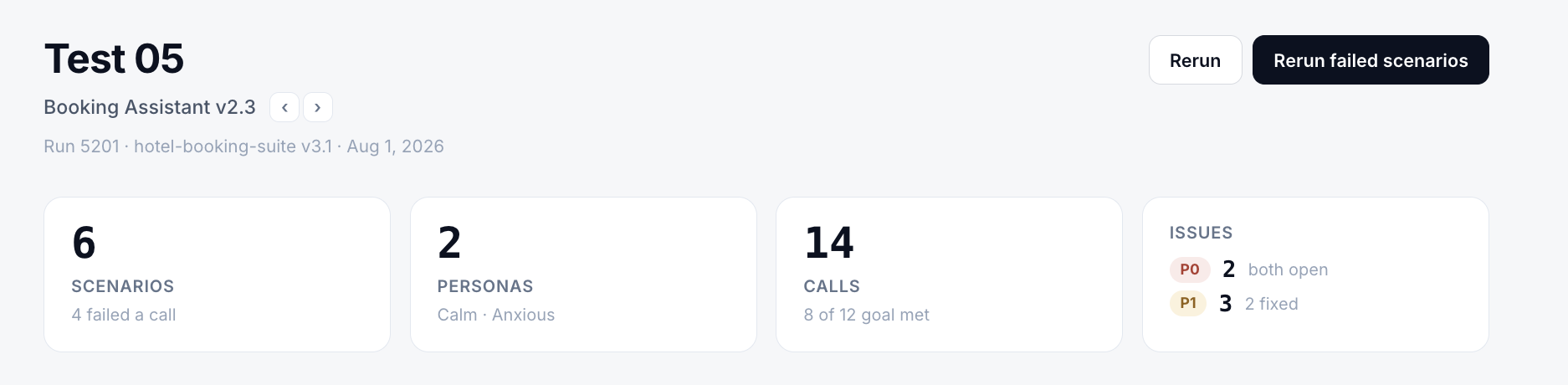
A Voice AI interaction should not be marked successful because the agent sounded correct. It should be marked successful only when the caller was understood, the conversation was handled appropriately, the correct action was completed, and the final outcome was verified.
The final takeaway
General LLM evals answer an important question: did the AI produce a correct, relevant, and safe response?
Voice AI evals must answer a much broader set of questions. Did the agent hear the caller correctly? Did it understand the caller's latest intention? Did it respond at the right time? Did it handle interruptions? Did it use the right tools? Did the business action succeed? Did the caller receive a natural and reliable experience?
That is why Voice AI evaluation cannot stop at the transcript or the language model. A production-ready voice agent must succeed across audio input, speech recognition, turn detection, language reasoning, context retention, tool execution, response latency, speech generation, conversation quality, and business resolution.
The most useful distinction is simple:
LLM evals evaluate the answer. Voice AI evals evaluate the conversation, the system, and the outcome.
Frequently asked questions
Voice AI evals are structured tests used to measure how accurately and reliably an AI voice agent handles spoken conversations. They evaluate speech recognition, reasoning, latency, turn-taking, interruption handling, tool use, speech quality, and task completion.
LLM evals primarily assess text-based response quality, including correctness, relevance, hallucination, safety, and tool use. Voice AI evals measure those areas plus audio understanding, latency, interruptions, turn-taking, pronunciation, telephony, and verified business outcomes.
LLM eval tools can evaluate the reasoning and language layers of a voice agent. They cannot fully evaluate the spoken experience unless they also analyze original audio, conversation timing, interruptions, speech output, tool execution, and backend outcomes.
Important Voice AI evaluation metrics include task-completion rate, intent accuracy, entity accuracy, tool-call success, end-to-end latency, interruption rate, turn-taking accuracy, repeated-question rate, speech naturalness, escalation rate, and backend outcome accuracy.
A transcript cannot fully show long silences, interruptions, overlapping speech, incorrect pronunciation, audio distortion, tone, or conversational timing. A transcript may appear correct even when the actual call was frustrating or unsuccessful.
End-to-end voice agent testing runs a complete spoken interaction through the audio, speech-recognition, reasoning, tool, speech-synthesis, and telephony layers. It verifies whether the complete system achieves the intended business outcome under realistic conditions.
Teams should combine text-based LLM evals, component testing, realistic multi-turn audio simulations, accent and noise variations, interruption testing, latency measurement, tool validation, human review, and production monitoring.
Vattara AI is an enterprise testing and observability platform that helps teams evaluate, test, monitor, and improve Voice AI agents across development and production. Vattara enables engineering, AI, QA, and product teams to simulate realistic conversations, identify voice-specific failures, evaluate agent behavior, validate backend outcomes, and understand why production calls succeed or fail.